\begin{equation}\label{divergent}
\int_a^b\frac{f(x)}{(x-x_0)^{n+1}}\mathrm{d}x, \; \; n=0, 1, 2, \dots .
\end{equation}with $f(x_0)\neq 0$. The basic assumption in the definition of the APV is that the function $f(x)$ has a complex extension $f(z)$, obtained by replacing the real variable $x$ with the complex variable $z$ in the function $f$, that is at least analytic in some region $R$ that contains the strip $[a,b]$ in its interior. The complex valued function $f(z)$ may have poles or branch points but none of them is inside $R$.
The analytic principal value is introduced by deforming the contour of integration in the divergent integral \eqref{divergent} into two paths in $R$ that both start at $a$ and end at $b$. One path, denoted by $\gamma^+$, passes above the point $z=x_0$; the other path, denoted by $\gamma^-$, passes below $x_0$. (See Figure below.) The two paths, taken together, form a Jordan curve enclosing the point $x_0$. The analytic principal value of the divergent integral \eqref{divergent} is now defined to be
\begin{equation}\label{apv}
\backslash\!\!\!\!\backslash\!\!\!\!\!\int_{a}^{b}\frac{f(x)}{(x-x_0)^{n+1}}\, \mathrm{d}x = \frac{1}{2} \int_{\gamma^+}\frac{f(z)}{(z-x_0)^{n+1}}\mathrm{d}z
\frac{1}{2} \int_{\gamma^-}\frac{f(z)}{(z-x_0)^{n+1}}\mathrm{d}z
\end{equation}Since the function $f(z)(z-x_0)^{-n-1}$ is analytic everywhere in the punctured region $R\setminus\{x_0\}$, the values of the integrals in the right-hand side of equation \eqref{apv} do not depend on the details of the paths $\gamma^{\pm}$.
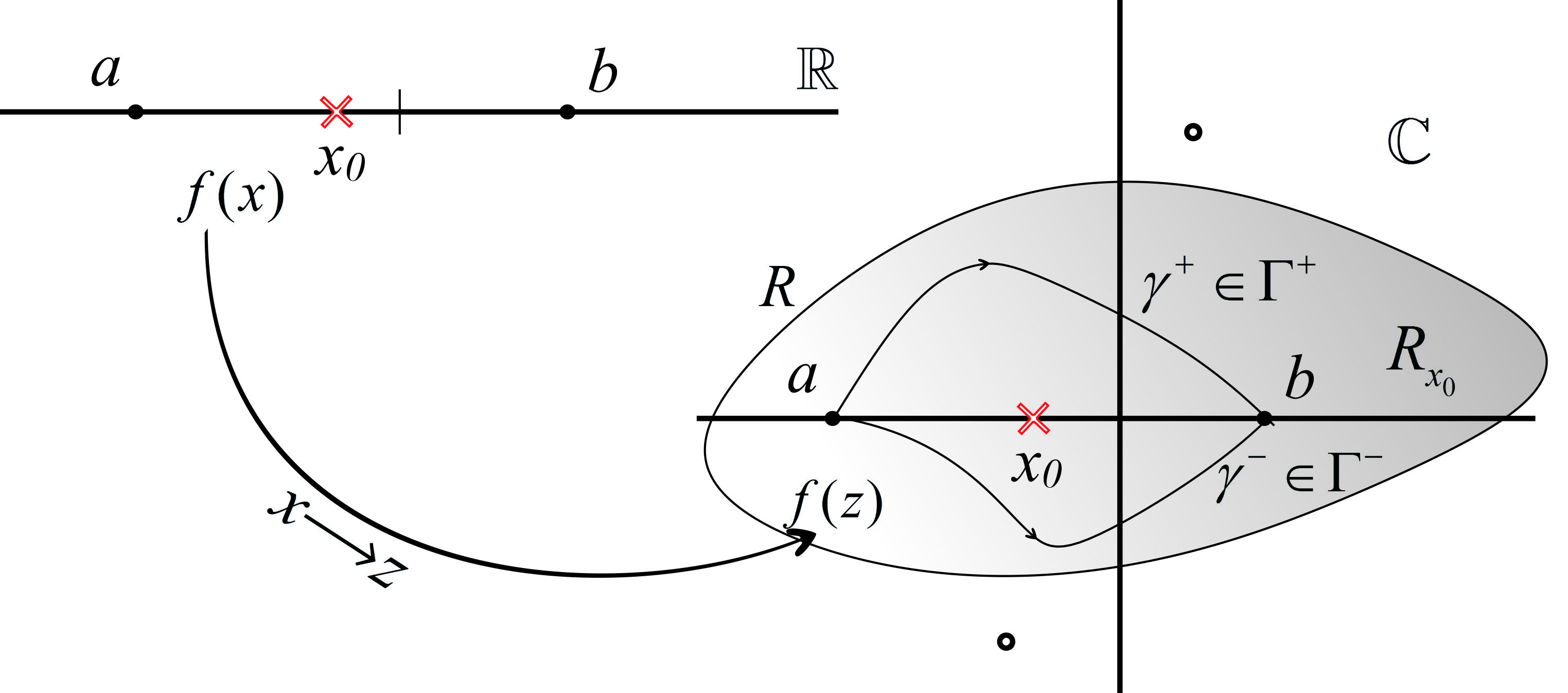
The mapping of the region of integration from the real line to a region in the complex plane. If $f(z)$ has poles, the region $R$ is chosen such that the poles, indicated by the hollow circles, are outside $R$.
By a continuous deformation of the paths $\gamma^{\pm}$ towards the original contour of the divergent integral \eqref{divergent}, it is shown that the APV assumes the value
\begin{eqnarray}
&&\backslash\!\!\!\!\backslash\!\!\!\!\!\int_{a}^{b} \frac{f(x)}{(x-x_0)^{n+1}} \mbox{d}x \nonumber \\
&&\hspace{12mm}=\lim_{\epsilon\rightarrow 0^+}\left[\int_a^{x_0-\epsilon} \frac{f(x)}{(x-x_0)^{n+1}} \mathrm{d}x+ \int_{x_0+\epsilon}^{b} \frac{f(x)}{(x-x_0)^{n+1}} \mathrm{d}x – H_n(x_0,\epsilon)\right],\label{fox}
\end{eqnarray}where
\begin{eqnarray}
H_n(x_0,\epsilon)&=&0, \;\;\; n=0\label{fox1} \\
H_n(x_0,\epsilon)&=& \sum_{k=0}^{n-1} \frac{f^{(k)}(x_0)}{k!(n-k)} \frac{(1-(-1)^{n-k})}{\epsilon^{n-k}},\;\;\; n=1, 2, \dots , \label{fox2}
\end{eqnarray}These values are just the Cauchy principal value for $n=0$ and the Hadamard Finite-Part Integral for positive integer $n$. Under the stated analyticity condition, the APV then reveals that the Cauchy principal value (CPV) and the Hadamard finite part integral (FPI) are values of absolutely convergent integrals.
Now in this post, I wish to show how the analytic principal value can be deduced from the Cauchy-Plemelj-Fox (CPF) theorem, thereby giving another proof to the equality of the APV with the CPV and the FPI. Central to the theorem is the function
\begin{equation}
\Phi(z)=\int_a^b\frac{f(x)}{(z-x_0)^{n+1}}\mathrm{d}x, \; \; n=0, 1, 2, \dots ,
\end{equation}where the contour of integration is the straight line connecting $a$ and $b$ and $z$ is nowhere in the contour of integration. Under certain conditions, the function $\Phi(z)$ approaches a meaningful value as $z\rightarrow x_0$, depending on whether the singular point $x_0$ is approached from above or below. These values, called as boundary values, are given by
\begin{equation}
\Phi^{\pm}(x_0)=\lim_{y\rightarrow 0}\int_a^b\frac{f(x)}{(x-(x_0\pm i y))^{n+1}}\mathrm{d}x, \;\; y>0 .
\end{equation}The Sokhostski-Plemelj-Fox theorem asserts that the Cauchy principal value (for $n=0$) and the Hadamard finite part integral (for $n=1,2,\dots$) are the simple averages of the corresponding boundary values so that we have the equality
\begin{equation}\label{equality}
\backslash\!\!\!\!\backslash\!\!\!\!\!\int_{a}^{b}\frac{f(x)}{(x-x_0)^{n+1}}\, \mathrm{d}x=\frac{1}{2}\left[\Phi^+(x_0)+\Phi^-(x_0)\right] ,
\end{equation}following from the equality of the APV with the Cauchy principal value and the Hadamard finite part integral with the appropriate value of $n$.
I now show how the analytic principal value arises from the Cauchy-Plemelj-Fox Theorem under the assumption that the complex extension, $f(z)$, of $f(x)$ is analytic in the same region $R$ introduced above. Then, for some sufficiently small $\epsilon>0$, the function $f(z)/(z-(x_0+i\epsilon))^{n+1}$ is analytic everywhere in $R$ except at $z=x_0+i\epsilon$, which is a pole of order $(n+1)$. Let $C$ be the closed contour comprising the straight line from $a$ to $b$ and the path $\gamma^+$ traversed in the opposite direction. Since $C$ encloses the pole $(x_0+i\epsilon)$, we have by the residue theorem
\begin{eqnarray}
\oint_C \frac{f(z)}{\left(z-(x_0+i \epsilon)\right)^{n+1}}\, \mathrm{d}z = 2\pi i \frac{f^{(n)}(x_0+i\epsilon)}{n!}
\end{eqnarray}On decomposing the contour in the left hand side of the equation along the straight path and the path through $\gamma^+$ and taking the limit $\epsilon\rightarrow 0$, we arrive at
\begin{eqnarray}
\lim_{\epsilon\rightarrow 0}\int_a^b \frac{f(x)}{(x-(x_0+i \epsilon))^{n+1}} \, \mathrm{d}x &=& \lim_{\epsilon\rightarrow 0} \int_{\gamma^+} \frac{f(z)}{\left(z-(x_0+i \epsilon)\right)^{n+1}}\, \mathrm{d}z \nonumber \\
&& \hspace{12mm} + \lim_{\epsilon\rightarrow 0} 2\pi i \frac{f^{(n)}(x_0+i\epsilon)}{n!}.
\end{eqnarray}
The left hand side is just the boundary value $\Phi^+(x_0)$. While the the limit and the integral cannot be interchanged in the left hand side because the integral will fail to converge under the interchange, the limit and the integral can be interchanged in the first term of the right hand side of the equation. Why?
Then we have
\begin{equation}
\Phi^+(x_0)=\int_{\gamma^+} \frac{f(z)}{(z-x_0)^{n+1}}\, \mathrm{d}z + 2\pi i \frac{f^{(n)}(x_0)}{n!}.\label{pos1}
\end{equation}On the other hand, if we close the contour below via the path $\gamma^-$ and perform the same limiting procedure, we obtain
\begin{equation}
\Phi^+(x_0)=\int_{\gamma^-} \frac{f(z)}{(z-x_0)^{n+1}}\, \mathrm{d}z\label{pos2}
\end{equation}where there is no residue term because the pole is outside the contour.
Also let us consider the function $f(z)/(z-(x_0-i\epsilon))^{n+1}$ still for sufficiently small $\epsilon>0$. Following the same steps done above for both closed contours above and below the real axis, we obtain
\begin{equation}
\Phi^-(x_0)=\int_{\gamma^+} \frac{f(z)}{(z-x_0)^{n+1}}\, \mathrm{d}z ,\label{neg1}
\end{equation}\begin{equation}
\Phi^-(x_0)=\int_{\gamma^-} \frac{f(z)}{(z-x_0)^{n+1}}\, \mathrm{d}z – 2\pi i \frac{f^{(n)}(x_0)}{n!}.\label{neg2}
\end{equation}
Either adding equations \eqref{pos1} and \eqref{neg2} or \eqref{pos2} and \eqref{neg1}, and dividing by $2$, and by use of the equality in equation \eqref{equality}, we reproduce the analytic principal value of the divergent integral given in equation \eqref{apv}, thereby giving another proof to the equality of the APV with the CPV and the FPI.
Does our new proof here render unnecessary the original proof of equation \eqref{fox}? No. The proof provided here and the original proof are independent of each other. And independent proofs typically provide different insights into the nature of what is being established. In the original proof, the equality of the APV with the CPV and FPI is established by a continuous deformation of the paths into the original contour containing the offending singularity. In the process, the explicit forms of the CPV and the FPI as limiting values given by equation \eqref{fox} arise naturally from the continuous deformation of the contour. (In the original paper of Fox, it is not immediately apparent how the term $H_n(x_0,\epsilon)$ in equation \eqref{fox} was arrived at; but by the original proof, it just emerges on its own.)
A little more contemplation on the original proof leads us to realize that the proof hints at the possibility of developing a full theory of divergent integrals via absolutely convergent contour integrals in the complex plane followed by continuous deformation of the contour towards a path containing non-integrable singularities. I’ll elaborate on this elsewhere.